still life

How to a Paint Still Life

Wednesday, March 25th, 2009
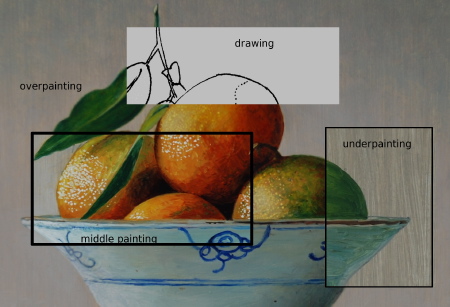
Stages in painting a still life in oil

Painting in layers with discrete stages (as seen above) is a powerful means to create realistic and expressive artwork. In this post I describe an example of the process with still life, although the methods are appropriate for any subject matter.
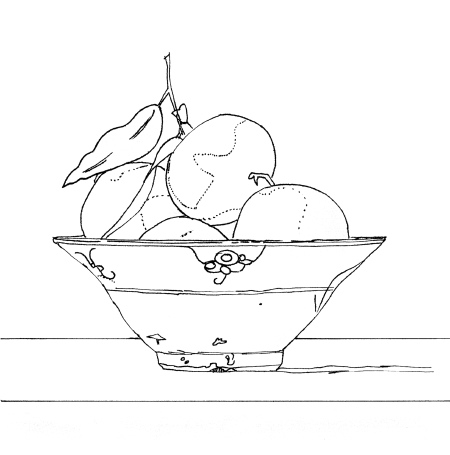
A simple underdrawing, black ink on a white gessoed panel. The black ink is high contrast against the ground. Is this a good way to start what I hope will be a subtle still life? In fact it is, because I am going to use a layered technique. The high contrast of this image introduces an important theme in layered painting: make something strong contrast, then paint over it to make more subtle contrast.

Stage 1) A simple underdrawing, black ink on a white gessoed panel.

The black ink in the drawing above has a high contrast against the ground. Is this a good way to start what I hope will be a subtle still life? In fact it is, because I am going to use a layered technique. The high contrast of this image introduces an important theme in layered painting: make something strong contrast, then paint over it to make more subtle contrast. [On the panel, the bowl is five and a half inches wide (i.e., 14 cm).]
Underpainting in oil

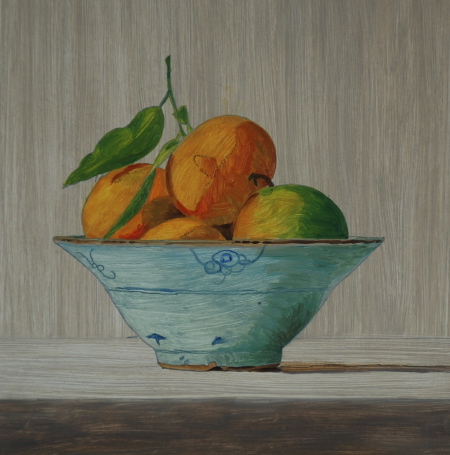
Stage 2) Underpainting in oil over the drawing.

The underpainting above is thin, direct and colorful, working out the basic forms without worrying too much about details in one painting session. Though the painting is thin, the drawing is now barely visible. If I had not used dark ink in the drawing, it would have been hidden by even a thin layer of paint; by using dark ink, I could still see the drawn details as I painted over the drawing. Before painting, the first thing I did was to mix the colors on my palette, where I could find a good color harmony.

In underpainting, I generally aim for warmer colors than I want in the finished work. I also added a little extra linseed oil to the colors so that they were a bit more fluid than straight tube colors. I generally paint without turpentine.

Look at how I apply the paint in the background in the underpainting stage above. It looks very streaky, doesn’t it? This is another example of making something high [or medium] contrast so that, after being covered by another layer or two, it will take on more subtle contrast. This streaky background pattern will later add a bit of texture to the painting, but it won’t jump out as it does now. Paintings that have smooth, perfectly blended surfaces tend to lack breath, they become suffocating and hard.
First overpainting

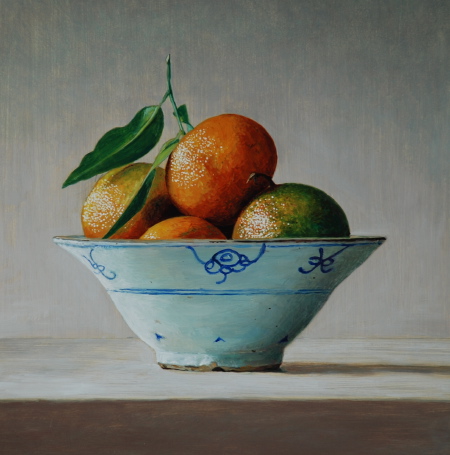
Stage 3) Overpainting, where I make the contrast stronger again, with attention to strong lights and darks.

Obviously, the underpainting (Stage 2) was dry before I painted over it. For the Stage 3, I use a bit of thickened linseed oil to make the paint more rich and rounded. I painted over the entire painting in one session, but quite thinly. The only thick parts are the highlights.

I’m accomplishing different things in Stage 3. On the one hand, I’m toning down some of the contrasts from Stage 2 (look at those streaks in the background, which can be seen in close-up in this post). But I also create some contrasts that are much stronger than I ultimately want to have (for example, the highlights on the fruit). The bowl and background are mostly finished at this stage.
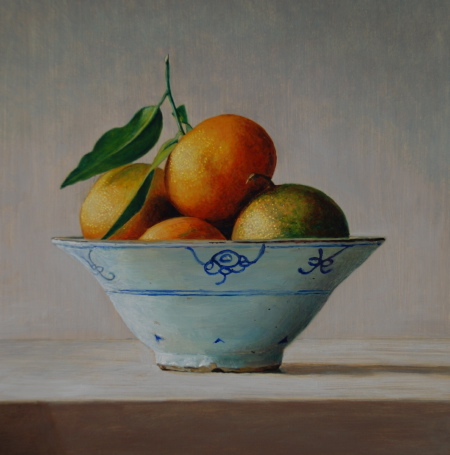
Second overpainting

Stage 4) Finishing touches.

In Stage 4 I finished the painting with a final overpainting. I painted sparingly, but the results were dramatic. On the lights of the mandarins, I put on a very thin layer of orange to mute the overly bright highlights from Stage 3 and unify the forms. I played with the leaves a bit, and I worked on the front side of the table. I made subtle changes elsewhere as well, for example toning down the light on the left side of the bowl. Finishing a painting takes time, but most of the time is spent just looking and thinking. The actually brushwork in Stage 4 was probably no more than five minutes.

People interested in art generally think that traditional oil painting involves many layers of transparent colored glazes. This isn’t quite accurate. Yes, layering is involved, but rarely did artists of the past need to make many more layers than I use here. Also, much of layered painting involves painting translucently rather than transparently. I use transparent colors for the dark colorful shadows. But in many places, I use opaque colors (e.g., mixtures containing white) that are nonetheless translucent because I paint thinly. A bit of opaque color will prevent a transparent glaze from having too hard and glassy effect. Painting with only transparent colors in oil gives an unpleasant effect, I think.

Could I have done this painting with acrylics instead of oils? Perhaps, but I think it would have been more difficult. In another post I discuss the differences between the two types of paints with respect to painting in layers.

Purple grapes (with update)

Wednesday, January 17th, 2007

By Hanneke van Oosterhout

Many people think of underpainting as a working in monochrome — either in grays, or browns. Artists of the past like Jan van Eyck used very colorful underpaintings. The usefulness of this I see in my painting of grapes.

I was painting these grapes from some dark purple-blue grapes in my studio. I made the underpainting much more bright, and warm, than real grapes, as you can see in the picture above.

When the first layer of oil paint was dry, I began overpainting, putting darker shadows over the grapes to make the colors more realistic, darker and cooler, as you can see above.

Here I have gone further with overpainting in another session. Now the grapes have a realistic color, but the brightness of the underpainting color shows through and gives life to the colors. If I had started with dark gray grapes, instead of a colorful underpainting, the colors would be dead when I did the overpainting. This this picture is not quite finished in the cloth. Here is where I left it yesterday afternoon.

Any suggestions?

dscn2912-450.jpg

(detail requested by Steve)

. . .

UPDATE

purple-grape-scan450b.jpg

I’ve gone further with this painting. I’ve been thinking a lot about your suggestions from last time while I was painting. What do I need to do to finish the picture? Any suggestions? For reference, the cloth is about 25 cm wide at its widest point. Here are some details of the picture: (more…)

New pencil drawings

Saturday, January 13th, 2007

By Hanneke van Oosterhout

Here are the drawings I have been working on in the new year.

(more…)

A question of viewpoint

Saturday, December 30th, 2006

Hanneke can’t post today and she asked me to fill in for her. I wanted to remark on an interesting trend in some of the comments about her work. For example, looking at an image of Old grapes, new painting, Colin Jago wrote “I seem to be looking down on the grapes and up at the glass.”

For Colorful Underpainting, Steve wrote “my first impression was that the cloth was somehow mounted on a wall. The bunch of grapes and the way they rest on it make this interpretation virtually impossible, of course, but I still don’t feel the correct perspective as strongly as I would like to.”

Hanneke paints her still life paintings “from life” and she tries to paint what she sees. Is she trying to show multiple viewpoints, or to produce distortion in perspective? Not intentionally, she has said. But is she doing so unintentionally?

Let’s take a look at Hanneke’s imaginary still life drawing and see if can find out more about the viewpoint issue.

In this imaginary still-life, the vessel is seen directly from the side, but the table top and fruit are seen from a different perspective, from above. We seem to look down on the table top while looking at the vessel from the side. This merging of different perspective points lends an interesting quality to the imaginary drawings. More examples of her “multiple viewpoint” imaginary drawings are here, here and here.

Let’s compare this to a drawing made directly from a real still life the same week when she made the imaginary drawings:

Do you see the difference? In this drawing from a real still-life, multiple viewpoints are not manifest. The fruit and the vessel are both seen from the same viewpoint.

I think that Colin and Steve are on to something with their comments about Hanneke’s painted still life work. In the “from life” still life paintings, the perspective may be technically correct, but she sometimes manages to produce a feeling of different viewpoints nonetheless. Would it be interesting if she tried to bring this difference in viewpoints more explicitly into her “from life” still life paintings? Or, should she work to correct the apparent flaw when it occurs?

What does it take to be a dealer?

Monday, December 18th, 2006

Still life by Hanneke van Oosterhout, detail

Last Friday I helped Hanneke and Maurice set up the exhibition at Galerie de Provenier. While doing this, I started to ask myself, “What does it take to be an art dealer?”

(more…)

Jannie Regnerus on Hanneke van Oosterhout

Monday, December 11th, 2006

Artist and writer Jannie Regnerus has collected three paintings by my partner, Hanneke van Oosterhout. I went to Jannie’s house today to make a photograph of one of the paintings and to see if there was any chance that she would consider reselling them.

(more…)

Old grapes, new painting

Saturday, November 18th, 2006

A drawing on paper (click image to enlarge):


. . .

Underdrawing on panel:

. . .

Underpainting with acrylic:


. . .

Overpainting with oil:


. . .

Overpainting with oil, second day (click image to enlarge):

. . .

Comments?

A painting a [in several] day[s]

Monday, November 6th, 2006

by Hanneke van Oosterhout

Recently we looked at one of Hanneke van Oosterhout’s finished still life paintings. There were a number of excellent critiques. The painting was already sold, however, so comments could have no further impact on that picture.

Now Hanneke is in the progress of making another still life. It is not yet finished, which means that your comments could help her make this painting better.

We can follow the painting’s development over several days. (more…)