from imagination

Is grownups’ art art?

Thursday, February 1st, 2007
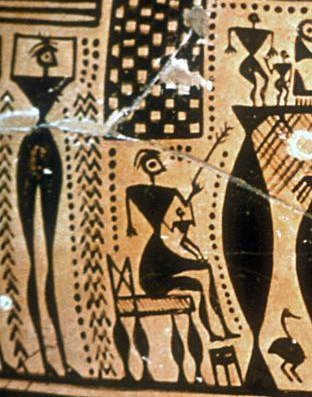
ancient.jpg

Detail from funeral pyre scene on an Attic Geometric krater, second half of 8th century BC
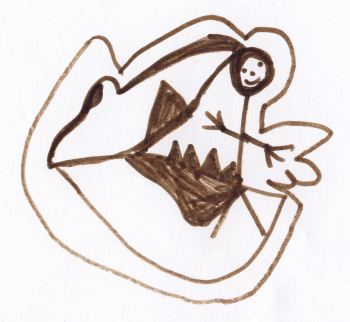
fran-drawing-end-jan-350.jpg

Man being eaten by a crocodile, first half of 21st century AD

The ceramic painting above I borrowed from Victor Bryant’s excellent ceramics website. The drawing on paper is by Fran, who is almost five years old.

The images are similar in that they both depict narrative scenes, and both make use of simple geometric shapes. The vase painting probably represents top quality artwork of its era, making use of a consistent representational system which covers this large vase and many others (presumably painted by many different adults working over many years). The children’s drawing is a one-of-a-kind sketch. (more…)

Françesca on “Is children’s art ‘Art’?”

Thursday, January 4th, 2007

Is children’s art “art”? Steve said that age does not matter; Derek, June, Bob and Arthur were ambivalent. I thought I should ask a Françesca (four and a half years old) for her opinion about what she makes, and also about work by “grownups.”

(more…)

A question of viewpoint

Saturday, December 30th, 2006

Hanneke can’t post today and she asked me to fill in for her. I wanted to remark on an interesting trend in some of the comments about her work. For example, looking at an image of Old grapes, new painting, Colin Jago wrote “I seem to be looking down on the grapes and up at the glass.”

For Colorful Underpainting, Steve wrote “my first impression was that the cloth was somehow mounted on a wall. The bunch of grapes and the way they rest on it make this interpretation virtually impossible, of course, but I still don’t feel the correct perspective as strongly as I would like to.”

Hanneke paints her still life paintings “from life” and she tries to paint what she sees. Is she trying to show multiple viewpoints, or to produce distortion in perspective? Not intentionally, she has said. But is she doing so unintentionally?

Let’s take a look at Hanneke’s imaginary still life drawing and see if can find out more about the viewpoint issue.

In this imaginary still-life, the vessel is seen directly from the side, but the table top and fruit are seen from a different perspective, from above. We seem to look down on the table top while looking at the vessel from the side. This merging of different perspective points lends an interesting quality to the imaginary drawings. More examples of her “multiple viewpoint” imaginary drawings are here, here and here.

Let’s compare this to a drawing made directly from a real still life the same week when she made the imaginary drawings:

Do you see the difference? In this drawing from a real still-life, multiple viewpoints are not manifest. The fruit and the vessel are both seen from the same viewpoint.

I think that Colin and Steve are on to something with their comments about Hanneke’s painted still life work. In the “from life” still life paintings, the perspective may be technically correct, but she sometimes manages to produce a feeling of different viewpoints nonetheless. Would it be interesting if she tried to bring this difference in viewpoints more explicitly into her “from life” still life paintings? Or, should she work to correct the apparent flaw when it occurs?

Kids online: Interview with Françesca

Monday, December 25th, 2006

Françesca’s fifth birthday is coming up in March.

Karl: Who do you want to see your drawings?

Fran: All the people from the whole world, and also grandma and grandpa.

(more…)

Kids online

Thursday, December 21st, 2006

Not long ago, Françesca enjoyed typing random letters into a text editor for about ten minutes a day. Now that she is nearing five years old, that doesn’t satisfy her any longer. She learned how to use the mouse, and she’s beginning to understand how to use the Safari web browser. She can spend an hour on-line without a break.What to do? This is the point where Hanneke and I have a choice. We can take the computer away and have our kids grow up in a “traditional” pre-internet household. Or we can let them go online and accept the consequences.

I am of two minds about this. One view is that the kids should be able to grow up in an internet-free home, the way we grew up. The opposing view is that the kids should go online because the internet is part of the world we live in — keeping the kids away from it would be like refusing to let them learn to read or write.

I am torn between these two views, but I am leaning toward letting her go online because:

  1. Our kids will come into contact with the internet no matter what we do.
  2. By guiding her internet use at home, we can help Fran find and be involved in the positive things on the internet; for example, looking at artwork by other children her age.
  3. The internet is intensely stimulating, of course. My response is that we need to make our “off-line” home environment even more fun, more stimulating, so that the internet is not such a magnet for the kids.

Anyone else out there with similar problems / opportunities?

Landscape by Tracy Helgeson: on the edge of abstraction

Sunday, November 5th, 2006

castshadow72-18x24200This landscape painting by Tracy Helgeson caught my eye. This work is something of a new departure in Tracy’s work, I think. She often works on the border between abstraction and reality, but in this painting there is a cross-over, albeit a subtle one. The result is almost unsettling, but I like it. A question for her is, does she want to go further with this? There is also a psychological element to this landscape painting, as I see it, which captures my attention.

Tracy’s blog raises interesting questions about what it means to be an artist today. In the past, artists liked to cloak themselves and their work in mystery. Tracy is open about her work (good, bad, unfinished) and her difficulties in the process of creating and selling. There is a refreshing and direct quality to her writing style that makes mysterious 20th century artists seem a bit comic in comparison. Is Tracy a good example of what 21th century artists will be doing, or should she hide her unfinished work and cultivate a more refined public image?

(un)still-life of the imagination

Saturday, October 14th, 2006
Imaginary still life in red chalk

Imaginary still life in red chalk by Hanneke van Oosterhout

Drawing still-life from her imagination has given a new dynamism to Hanneke’s work. Look at the rhythm of the forms she creates here. This looks like it would be awfully complex to paint (and where is she going to find a skull?).

Art & Imagination, part II

Monday, April 24th, 2006

Cennino Cennini devotes his Il Libro dell’ Arte (late 14th c.) to a practical explanation of the materials and techniques of painting. And yet Cennino also writes of painting as an occupation that deserves “to be crowned with poetry”, because the painter has the ability to compose from the imagination, “presenting to plain sight what does not actually exist.”
It might seem there is a mismatch between focusing on the physical aspects of the work, and at the same time emphasizing the role of imagination in creating art. But this combination of the mundane and the fanciful is appropriate for a simple reason: an artist creating from the world of the mind must nonetheless work in the world of the materials. The physical nature of those materials, and the way the artist uses them, will inevitably influence how the inner world of the mind is discovered and expressed.

Contemporary artist Hanneke van den Bergh recognizes and makes use of this interplay of the imaginary and the physical in her clay sculpture. She explains “I like to make the heads by moving a little lump of clay until I can just see the face. I like this quality of the imaginary form beginning to emerge from the raw material.” Van den Bergh does not attempt to disguise the properties of her materials. In the example shown here, Danae III, she leaves visible the coils with which she constructs the main form. The contrast of the repeating pattern of coils with the rhythm of the body contributes to the expressive effect of the work. “By avoiding too much detail,” she says, “I maintain the contrast between material — the physical — and the imaginary.”

_________
Related:
Art and imagination: Cennino says…