How to Gild a Frame
Tuesday, March 31st, 2009
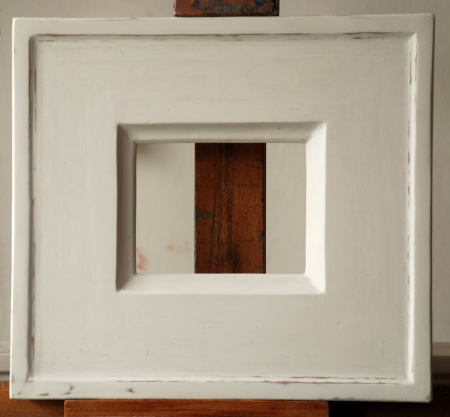
A frame covered with acrylic gesso, ready to begin with the gilding process. I have previously sanded the gesso with wet emery paper and polished with the finest paper where the gold is to come.

A frame covered with acrylic gesso, ready to begin with the gilding process. I have previously sanded the gesso with wet emery paper and polished with the finest paper where the gold is to come.
On the question of how to frame pictures for exhibition, Angela Ferreira commented:
I think the best way to exhibit any painting to appeal to a wide variety of buyers is to display it with a very simple effective frame, or leave the canvas unframed. Framing can be distracting and might not appeal to some — most people like buying a painting and then framing it to their own house style.
Of course, a painting only has to appeal to one buyer — the one who takes it home. In this way, a painting is different from a book or a song. Most people know how challenging it is to frame a picture. If the artist does a good job in choosing a frame, this can save the buyer a lot of effort and decision-making.
The right frame can enhance the value of a painting. But the artist takes a risk in framing, as Angela implies. The time and money invested on the frames may not be well spent.
Should artists consider the frame as an integral part of their work and strive to get it right, whatever the risk or complexity? Or is it better to leave framing to the buyer?
[See the poll at the top of this blog, right column]
[See also post on Photostream]
It is somewhat rare to show framed pictures on the internet. Perhaps this is because the internet is something of a frame in itself. We are here following Hanneke van Oosterhout’s still-life painting, from the drawing to (hopefully) the gallery-sold work; in real life her work benefits from the real type of frame.
Choosing a good frame is difficult. Compared to painting the painting, choosing the frame is highly constrained by one factor in particular: cost. The ideal frame can raise the market value of a painting, but before an exhibition, one does not know what will sell. Investing in the frame is therefore a sort of speculation. For the painting above, Hanneke felt she made a satisfactory choice. The physical texture of the frame complements that painted in the shells. The frame is made from pre-fabricated profile stock and was not inordinately expensive. In the photo it looks pretty good. But in real life the frame screams, “second rate quality!” The reason for this is simple. The physical texture of the profile stock, prefabricated rather than hand crafted for this frame, does not “mesh” at the corners where the profile was cut and joined together. This subtle aspect is important in real life. It undercuts the value of the frame (and the painting) for the discerning collector. I suppose the really discerning collector would buy the painting and invest in a new frame.
In the work above, the frame is hand-crafted. That is to say, someone did some work decorating the frame after the corners were joined. In the photo, this is not obvious, but in real life, it makes a big difference in the feeling of the frame, its feeling of worth. Of course, this type of frame is somewhat more expensive. But if a painting is good, a certain quality (and expense) of frame is called for, otherwise the frame drags the painting down. A good frame helps, but better no frame than the wrong frame.
The frame depicted above (sorry about the quality of the photo) is made from pre-fabricated stock, the type of frame you can buy at a normal frame-making shop. Although not “hand finished” it does not have a “cheap” feel to it. The reason is clear: the profile “meshes” at the corners, because of its simple form. A handcrafted frame of a similar profile would appear more sophisticated, but the frame above does quite well. Or does it? You comments, as always, are appreciated.

Certain types of paintings should be framed. Framing poses a challenge for the artist. The choice of frame will have a great impact on the appearance of the work. Yet the painter here must generally make a selection, rather than create the frame him or herself (possible, of course, but an artform in itself and very time-consuming). Hanneke van Oosterhout is struggling with the great frame problem with her still-lifes now. See Follow the Painting.
The design of web-pages for displaying art is a matter of great practical as well as aesthetic importance. One design that I find striking, because of its boldness, is Jannie Regnerus’ web-page. This page (detail below) is minimal to the extreme. It is so unlike what one is used to in a web-page that at first it seems confusing. But it is precisely this unusual quality that makes the layout a successful frame for Regnerus’ photography. One has the feeling of having left the noisy bustle of the internet and having arrived in a quiet place.
![[image: a screen shot of a minimalist website] [image: screen shot of minimalist website]](http://www.karlzipser.com/jpg/jannie.jpg)
I say the design is bold is because, by departing from expectations, Regnerus takes a risk that visitors may be confused and leave the site before they see anything. For those visitors who do look more closely, the simplicity of the layout serves the intended role of providing a quiet context for the artwork.
Is minimalism inherently good for the internet?
Is Regnerus’ site a model for other internet sites?