being an artist

About Karl Zipser

Thursday, March 19th, 2009
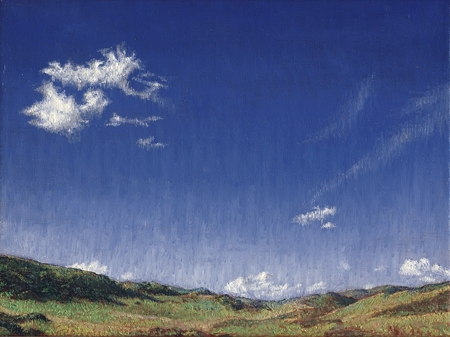
Dune Landscape, 2006, oil on canvas
Dune Landscape, 2007
oil on canvas, 18 x 24 cm

I was born in New York City in 1969. My parents encouraged me to draw and paint from a young age. As a teenager, I painted landscapes in oil, but I felt that I should seek a more practical career.

I went to college at the University of Chicago and got my BA in biology in 1991. After that I did research at the Massachusetts Institute of Technology in the Department of Brain and Cognitive Sciences. I studied visual perception and the primate visual system. I got my Ph.D. in 1995.

During post-doctoral research in Amsterdam, I rediscovered my interest in art and decided to become a painter. I had an exhibition at Galerie Klerkx & van Heerden in Haarlem, The Netherlands in 2001. Since then most of my work has been for private commission.

Staying with the New Year’s resolutions

Wednesday, January 3rd, 2007

I found a good trick for making progress with the daily New Year’s resolutions: don’t go online until they are complete.

Another lesson I have learned already is to do the tasks as early in the day as possible. It is easy to procrastinate, and then at some point it becomes too late to do anything.

Another one of my resolutions is to write a bit of fiction each day. To keep it simple, I’m starting with a children’s story. This is a lot of fun.

How to stay with my New Year’s resolutions?

Tuesday, January 2nd, 2007

I set myself some ambitious New Year’s resolutions: to draw, paint, sculpt and do photography every single day. January 1st was a success, but how long will I be able to keep up with this?

I think that good planning will help. It was a lucky accident that I had some clay here at my grandmother’s house where I am spending the holidays, otherwise I would not have been able to the sculpture work (or rather, “exercise”) yesterday. I have painting materials here that let me paint daily as well. But what about the future?
It is clear to me that I need to make some sort of traveling kit to carry my essential art materials with me wherever I go.

For ordinary days, I will need to make sure that I keep everything organized so that the “energy barrier” for starting with each type of work remains as low as possible.

I guess I should add that another one of my New Year’s resolutions is to write a blog post every single day.

Staying artistically fit in 2007

Monday, January 1st, 2007

Thanks to my New Years resolutions, I took my camera on my walk this morning. Making photos every day — what’s the big deal? Photography is just a matter of pressing a button, right?

I did the same walk around the harbor that I do every day when I am in Wilhelmshaven. But today I felt exhausted afterwards, and it wasn’t from the physical weight of the camera. I felt tired because I used my out-of-shape “photographic vision,” a special way of looking at the world through a camera. It took about half an hour of walking and shooting to get into “photographic vision,” and it now persists for some time after I put down the camera. “Photographic vision” lets me take photographs without using a camera, in a sense. I assume all the photographers have this; probably the professionals live with it all the time. For an amateur like me, it yields a sort of “mental muscle ache,” something like what you feel when you first start exercising muscles that you didn’t realize you had. All the more reason for the daily workout!

Art resolutions for the New Year

Sunday, December 31st, 2006

Do not fail, as you go on, to draw something every day, for no matter how little it is it will be well worth while, and will do you a world of good.

Cennino Cennini, Il Libro dell’Arte

In 2006 I made sculpture; at the close of the year I began to take an interest in photography. What I found was that weeks could pass without my even touching a paint brush. Recently, I have been painting daily without doing any sculpture or photography at all.

Is it good to abandon one art form for another, even temporarily? One could argue that, in some cases, it is good. But here is another way to think about it, in analogy to physical exercise: would it be good to give up daily exercise for the sake of art? Thinking of it this way, the answer is, of course not.

My goal for 2007 is to draw, to paint, to do sculpture and to do photography, every single day.

My goal is not to try to accomplish something remarkable every day in these various media. The goal is to keep myself in “condition” or “artistically fit” in the same way that I stay “physically fit.” Stated in this way, I don’t think this New Year’s resolution is too ambitious to follow. We shall see . . .

Do you have New Year’s resolutions pertaining to art that you would like to share?

Is children’s art “Art”?

Thursday, December 28th, 2006

It’s easy to say, “all children are artists,” or “everyone is born an artist.” But let’s be serious: how old do you have to be before people take you seriously as an artist?

If you are recognized as an artist as an adult, does your “early work” then become art as well? What if your “early work” was not so good? What if (as in the case of my sister Nina) only your “early work” was good?

Does an artist need to be older than ten to make real art? Is children’s art “Art”?

. . .

related post: Edward Winkleman, What Is an “Emerging Artist”?

Wedded to art: Jennifer Hoes, the woman who married herself

Monday, December 11th, 2006


KARL ZIPSER: Jennifer, why did you marry yourself?

JENNIFER HOES: I married myself at the moment I was prepared to embrace my own life and agree on the responsibilities that come with that. I married myself at the age my father died, I decided not to stay in the shade of his death at thirty. (more…)

Interview with Walter Bartman

Monday, November 20th, 2006

Walter Bartman was my art teacher in high school in 1984-86 in Bethesda, Maryland. Students of “Mr. Bartman” were ten times more likely to become Presidential Scholars in Visual Arts than students in other art classes in the United States. Although he retired from high school teaching in 2001, Walter Bartman continues to teach landscape painting in Maryland and in workshops across the U.S. and in Europe.

Artwork in this post is plein air painting by Walter Bartman [click images to enlarge]. This interview was edited for publication together with Leslie Holt
(more…)

Haarlem art: new life in a cultural graveyard?

Monday, November 13th, 2006

Haarlem is a major art center — in historical terms. When the genres of landscape and still life were revolutionary and new (in the 17th century), Haarlem artists were the key players. The Haarlem portrait painter Frans Hals is one of the most influential artists in history. Much of what is best about Manet‘s work he borrowed directly from Frans Hals. Van Gogh was hugely influenced by Frans Hals as well.

Haarlem also has one of the greatest Michelangelo drawing collections in the world. But this is a dead collection, in a sense: in a recent major exhibition in Haarlem, artists were not permitted to study Michelangelo’s work in the only way that makes sense, drawing within the exhibition itself, looking directly at the master’s work. Although there was a huge volume of visitors to the show, there was almost no serious critical analysis of the art or the exhibition (here are exceptions: 1, 2).

Thus, Haarlem is a cultural graveyard. Haarlem’s living inhabitants treat the past with silent, uncritical reverence. The tombstones of the old masters (native and foreign), cast a long shadow over contemporary artwork and creativity.

Artists in Haarlem today can be divided into two broad categories:

  • those trying continue past traditions (especially in still life painting)
  • those trying to be part of the great international art scene.

In the first category are some talented painters achieving commercial success with their neo-17th century still life paintings. But in this endeavor, they are little more than expert craftsmen. [Hanneke van Oosterhout is flirting with the idea becoming one of these, but I think she will pull out before it is too late].

In the second category are artists who are in denial about their place of residence. These artists would probably be better off if they moved to the real international art centers of today — New York, London, Berlin. How can one be a great international artist living in Haarlem, of all places?

Before we all pack up and move to New York, I’d like to point out that the action in the great living art centers of today is not all that impressive. I’ve spent a lot of time in New York and Berlin, with an eye to moving there for the sake of my art career. I was singularly unimpressed by what I saw in the living art culture. I might move to New York for its great museums, but not for its contemporary galleries.

More interesting to me than moving is to look at this cultural graveyard I live in, and see what are the weeds growing besides the tombstones. What is the new life here? Might it grow into something for the city to be proud of?

Where do you live and work? Could your city or town become an important art center? Or would you rather move to New York?

. . .

In a future post, I will profile what I consider to be the most exciting contemporary Haarlem artwork.

Landscape by Tracy Helgeson: on the edge of abstraction

Sunday, November 5th, 2006

castshadow72-18x24200This landscape painting by Tracy Helgeson caught my eye. This work is something of a new departure in Tracy’s work, I think. She often works on the border between abstraction and reality, but in this painting there is a cross-over, albeit a subtle one. The result is almost unsettling, but I like it. A question for her is, does she want to go further with this? There is also a psychological element to this landscape painting, as I see it, which captures my attention.

Tracy’s blog raises interesting questions about what it means to be an artist today. In the past, artists liked to cloak themselves and their work in mystery. Tracy is open about her work (good, bad, unfinished) and her difficulties in the process of creating and selling. There is a refreshing and direct quality to her writing style that makes mysterious 20th century artists seem a bit comic in comparison. Is Tracy a good example of what 21th century artists will be doing, or should she hide her unfinished work and cultivate a more refined public image?

Fall of the Art World

Friday, October 13th, 2006

Looking back at this piece (first posted 4 May) I can laugh at the melodramatic style. But I confess that I am still under its spell. Fall of the Art world continues to influence my world view, how I look at things like the Painting a Day movement. Which is to say, I could use some serious criticism of this piece. Tear it down, if you can.

(more…)

Artist: constraints are your friends

Friday, October 6th, 2006

One lesson we can draw from the 20th C. is that total freedom for the artist is not the path to happiness. Never have there been fewer constraints on what an artist can do, and never has the life of the artist (relative to other professions at least) been so wretched.

. . .

The drawbacks of total freedom should not surprise a physicist or an athlete. Certain mathematical problems are difficult or impossible to solve without a sufficient number of constraints. Without the constraints of rules, sports would be chaos.

We can see evidence for the longing for constraints in the most important painting movement of our time: the Painting a Day phenomenon. What is the explicit purpose of this movement? It is a pure statement of constraint. There must be one painting per day. This constraint severely limits what an artist can produce on a canvas. The enthusiasm with which artists are joining this movement demonstrates the hunger for constraints, for simplicity, for order. After all, you can’t rebel against nothing, can you?

But you don’t need to become a Painting a Day painter to have constraints. All you need to do is think about your own situation as an artist and examine what constraints you already have. And then, of course, to appreciate them and make the most of them.

One year I had no studio for a few months. I needed to work at home, so I drew in my sketchbook each day instead of painting. The work that I designed then I later painted and sold for a lot of money. The constraint of having no studio, temporarily, in fact helped me a great deal.

In order to make the most of your constraints, you need to be aware of what they are. Everyone has limitations of time, space, and talent. The particular mix that you have will influence what you do — much as will the mix of your painting medium or selection of your palette. The practical acceptance of constraints is the key to using the constraints in a positive way. It helps to remember that more opportunity and freedom would not necessarily help you.

So, let’s get to work . . .

Art and Offspring

Monday, August 7th, 2006

Here is a statement attributed to Michelangelo in Vasari‘s Lives of the Artists that I keep thinking about:

I’ve always had only too harassing a wife in this demanding art of mine, and the works I leave behind will be my sons. Even if they are nothing, they will live for a while. It would have been a disaster for Lorenzo Ghiberti if he hadn’t made the doors of San Giovanni, seeing that they are still standing whereas his children and grandchildren sold and squandered all he left.

Studying images and style

Saturday, May 27th, 2006

Drawing or painting from photographs is inherently different from working from life, because when working from a photograph, the subject of the work is a static image. Studying images has always played an important role in art, although the images in the past were of course not photographs, but works by other artists. As Cennino Cennini recommended in the 14th century:

take pains and pleasure in constantly copying the best things which you can find done by the hand of great masters. And if you are in a place where many good masters have been, so much the better for you. But I give you this advice: take care to select the best one every time, and the one who has the greatest reputation. And, as you go on from day to day, it will be against nature if you do not get some grasp of his style and of his spirit.

The style and spirit of the artist to be copied is as important as the subject of the artwork itself. Cennino emphasizes this point by directing the student to study one master at a time:

For if you undertake to copy after one master today and after another one tomorrow, you will not acquire the style of one or the other, and you will inevitably, through enthusiasm, become capricious, because each style will be distracting your mind. You will try to work in this man’s way today, and in the other’s tomorrow, and so you will not get either of them right.

This idea of copying another artist’s work to study style is perhaps alien to our contemporary ideas of how an artist should develop. But the goal, development of a personal style, is something that all artists share:

If you follow the course of one man through constant practice, your intelligence would have to be crude indeed for you not to get some nourishment from it. Then you will find, if nature has granted your any imagination at all, that you will eventually acquire a style individual to yourself, and it cannot help being good; because your hand and your mind, being always accustomed to gather flowers, would ill know how to pluck thorns.

How can we relate this approach of copying other artists to the practice of working from photographs? Dan Bodner said recently, “We cannot separate how we see from the way photography has informed our vision.” This seems consistent with Cennino’s writing. An artist who works continually from the photograph will, intentionally or not, acquire the “style and spirit” of the photograph. The camera thus becomes the artist’s master. Dan Bodner seems to have escaped this because he already developed a personal style before turning to photography as a source.

A Challenge to Artists

Wednesday, May 3rd, 2006

Why is it so difficult to be an artist? CB responded:

How can any one living in the developed world, with enough money & free time to waste it dicking around with a website and on [an art discussion group], in anyway consider their life or even their work “hard”? Living in Iraq would be hard, farming in Sudan would be hard, having a degenerative painful disease would be hard. But for artists to pretend to be in the same boat is just self-involved nonsense. Certainly it was true prior to the 1900′s ( when no sales amounted to starvation), or for those who had to face down a Stalin or a Hitler or a Mao, but now? just suck it up and quit yer whining….

Here is what CB makes me ask myself:

  • Do I wake up before sunrise to put my best into my art while most people are still sleeping?
  • Do I paint as though my very existence depended on it?
  • And if not, why not?

CB does not aim at popularity with his writing style. But I think his advice — “just suck it up and quit yer whining” — is valuable. The reason is that I think “the art world”, as we know it, is about to fall apart. There are going to be tremendous opportunities for artists in the near future, but it will take some guts to make the most of them.

____________________
Related: Why is it so difficult to be an artist?