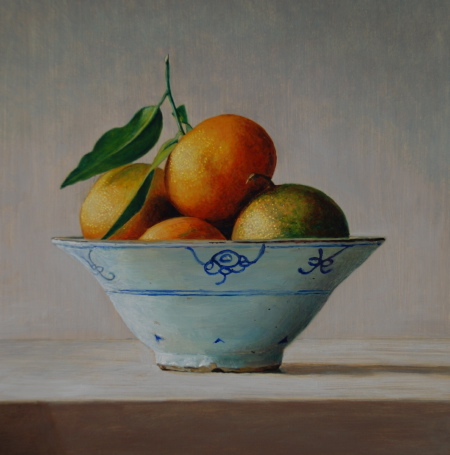
painting

Old grapes, new painting

Saturday, November 18th, 2006

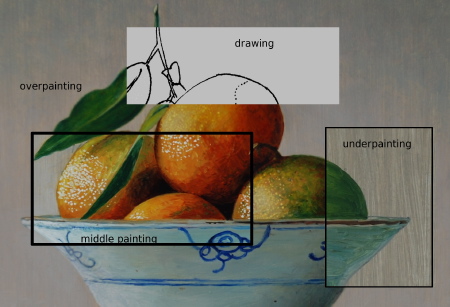
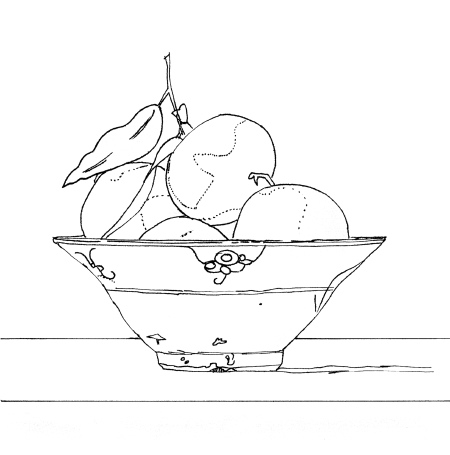
A drawing on paper (click image to enlarge):


. . .

Underdrawing on panel:

. . .

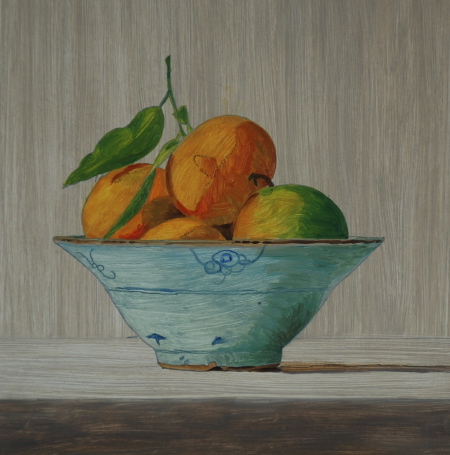
Underpainting with acrylic:


. . .

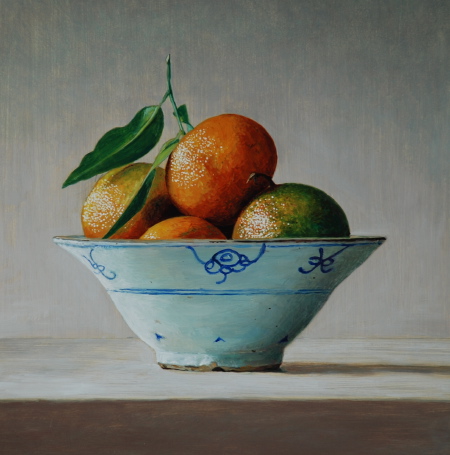
Overpainting with oil:


. . .

Overpainting with oil, second day (click image to enlarge):

. . .

Comments?

Critique Me!

Saturday, November 11th, 2006

Hanneke van Oosterhout recently showed this painting in earlier states. She got valuable suggestions from Rex, David, Colin, Jon, and Jewel as to how to improve the picture. Rather than respond in words, she has responded by modifying the painting itself. The latest version is shown above [click image to enlarge].

Is the painting finished?

A painting a [in several] day[s]

Monday, November 6th, 2006

by Hanneke van Oosterhout

Recently we looked at one of Hanneke van Oosterhout‘s finished still life paintings. There were a number of excellent critiques. The painting was already sold, however, so comments could have no further impact on that picture.

Now Hanneke is in the progress of making another still life. It is not yet finished, which means that your comments could help her make this painting better.

We can follow the painting’s development over several days. (more…)

Landscape by Tracy Helgeson: on the edge of abstraction

Sunday, November 5th, 2006

castshadow72-18x24200This landscape painting by Tracy Helgeson caught my eye. This work is something of a new departure in Tracy’s work, I think. She often works on the border between abstraction and reality, but in this painting there is a cross-over, albeit a subtle one. The result is almost unsettling, but I like it. A question for her is, does she want to go further with this? There is also a psychological element to this landscape painting, as I see it, which captures my attention.

Tracy’s blog raises interesting questions about what it means to be an artist today. In the past, artists liked to cloak themselves and their work in mystery. Tracy is open about her work (good, bad, unfinished) and her difficulties in the process of creating and selling. There is a refreshing and direct quality to her writing style that makes mysterious 20th century artists seem a bit comic in comparison. Is Tracy a good example of what 21th century artists will be doing, or should she hide her unfinished work and cultivate a more refined public image?

Blues of the Past

Friday, November 3rd, 2006

Sometime in the 14th century, Cennino d’Andrea Cennini wrote Il Libro dell’ Arte. The book is a treasure because of its detailed information about a wide range of artistic techniques. For Cennini and his contemporaries, using natural mineral pigments was the best option available to create intense and lightfast blue colors.Mineral azurite yields a handsome blue pigment, somewhat “warm” or inclined slightly towards green. Ultramarine was purified by a labor-intensive process from the lapis lazuli stone, and yielded the most pure blue available. Although the stone itself was semi-precious, the purified pigment was considered a treasure.

These natural blue colors are intense, but not so intense as modern synthetic colors. This meant that painters of past centuries could strive to produce the strongest blues possible, and still arrive at results that were poetic, rather than garish. In contrast, the modern painter, working with colors from a tube, must often fight with the colors, to take away some of their overpowering intensity.

The painting here is an “imaginary portrait” which I painted with oil on panel in 2002. The blues here are underpainted in azurite, and overpainted with natural purified ultramarine, using varying admixtures of white. Differences in the pigment particle size and the degree of purification have an important influence on the colors.

Below are two magnfied views of the painting. In each detail, there is small regions of the warm blue azurite underpainting visible, where the ultramarine (darker blue) does not cover the underpainting completely. Notice the granular quality of the blue pigments, compared to the more uniform mixtures in the skin colors.

(first posted 14 March 2006; update with magnified views, 3 November 2006)

Vase making and painting

Wednesday, November 1st, 2006

This ceramic vase is based on an ancient Greek form, known today as a Stamnos.

This vase is made from four separate pieces: the body and foot; the mouth; the two handles.

Using a yellowish clay, I threw the body/foot on a potter’s wheel, then set this aside to become leather hard. Next I threw the mouth, a short cylinder. When it was leather hard, I attached it to the body with clay slip. I put the vase back on the wheel and refined the form using a wire loop tool. I then burnished the vase with a smooth stone as it rotated on the wheel. The handles were pulled from a lump of clay. When these were leather hard, I attached them to the body with clay slip, then burnished these also.

I drew figures on both sides of the vase with pencil, then redrew the design with a fine clay slip called terra sigillata, which here is brown. After painting the remainder of the vase with this material, I polished with a cloth to give it a metallic shine (click images to enlarge).

I learned how to make vases by reading the book Athenian Vase Construction by Toby Schreiber.

I learned about painting them from the book The Techniques of Painted Attic Pottery by Joseph Veach Noble.

I learned critical information about terra sigillata from Vince Pitelka’s website.

Pears and personification

Wednesday, September 27th, 2006

Here are two paintings of pears in which Hanneke van Oosterhout seems to express human personalities.


Look how different are the characters she has painted.


In the first painting, the pears seem innocent, perhaps prudish. In the second painting, the fruit is sensuous and, well, quite the opposite of prudish. In the first painting the pears seem not quite ripe. In the second painting, the surface of the pears shows they are at their sweetest, but will soon be too old.

Both paintings use a bowl to contain the pears. But the tone here is different as are the pears. In the first painting, the blue ceramic, broken and reassembled, has a world-weary character that forms an interesting contrast with the fruit. In the second painting, the bowl serves as a container, but is otherwise more neutral.

The neat folds of the cloth in the second painting are an interesting contrast with the wild disarray of the pears. In the first painting, the tabletop is more stark and hard.

These pictures make one think about what goes on in Hanneke’s mind. “I didn’t paint them like this on purpose!” she insists. I wonder if I believe that.

Reflections

Saturday, September 23rd, 2006

Sometimes realistic painting can look unreal, as with the reflection of the foot of this bowl in the bowl itself. Should the artist be faithful to reality, even when it is confusing? Hanneke van Oosterhout struggles with this question in Follow the Painting.

Small changes . . .

Thursday, September 21st, 2006


Amka compared painting to the process of writing: “Something doesn’t quite work, and the author can add a sentence, or remove something, change it up just a bit and suddenly it comes alive.”

Making a small change can also change the storyline. How has Hanneke van Oosterhout changed this painting with the addition of the rozebottel? See Follow the Painting.

Painting done, but not finished? Then push it further…

Wednesday, September 20th, 2006


Hanneke van Oosterhout pushes this still life further. See Follow the Painting for the progress.

Vijgen in een Doos (figs in a box)

Wednesday, September 13th, 2006


This painting fascinates me. Hanneke van Oosterhout has painted figs with personality. This is almost a group portrait. I sometimes wonder, “Does the world really need more still-life paintings?” This picture answers, “Yes!” Hanneke is pushing the limits of this genre.

Emaille Kopje (enamel cup)

Tuesday, September 12th, 2006

Some time ago Hanneke van Oosterhout showed me an old cup that she had bought at an antique market. I thought to myself, “what a piece of junk.”


Hanneke took the cup to her studio and made this drawing. She then transferred it to a panel and painted it. Initially, there was a cloth under the cup (as in the drawing), but she was not satisfied with this, so she painted it over with white and light grays, adding a bit of raw sienna to the grey for warmth in the foreground (a color effect to bring the front part of the table/base forward).


Lately, Hanneke van Oosterhout’s still-life paintings have affected the way I look at things. I notice myself observing fruit and ordinary objects like ceramics in a different way. I see the beauty in them. Hanneke says, “That’s the way it is for me all the time. That’s why I am so eager to paint everything I see!”

Koninginnendag (queen’s day)

Sunday, September 10th, 2006


This painting by Hanneke van Oosterhout is in an interesting state (click painting to enlarge it). Originally it had a black background, but Hanneke found this an ugly combination with the orange colors. For this reason, she painted the background white, in order to make a new start with it. However, she painted the white thinly, and the background is not really white now, but has an interesting cloudy quality. Although not planned, this is a perfect example of the type of optical effect that can be achieved by painting in layers. The cloudy quality that results gives a feeling of mystery to the still-life which would not be there if the background were pure white.

I don’t know what Hanneke’s plans are for this picture. It will be interesting to follow how it develops, and if she decides to keep some of this accidental background quality, or make something different. I like the cool background grays that contrast nicely with the warm grays in the objects. What do you think?

Witte Aalbessen (white berries)

Thursday, September 7th, 2006


Here is a drawing of witte aalbessen that Hanneke van Oosterhout made this June (click the images to enlarge). The same day she transferred the drawing to a panel using tracing paper. Then she made an underpainting with acrylic.

The next day she over-painted all the berries with oil paint, a tiring day’s work. Why did she paint them all in one day? “Yes, the berries go away quickly,” says Hanneke. She wanted to capture the fresh, ripe quality of the fruit before the berries dried.


 Some weeks later she over-painted the cup and the background in about half a day, again with oils. The result is shown here.

A detail shows the spontaneous but refined brushwork used to paint the berries — the shiny transparent skin and translucent interior. “That is the magic of these white berries, that you can look inside,” says Hanneke. “That’s why I worked so hard to paint them when they were fresh.” On the panel each berry is about 7 mm wide.

Two and a half days work is fast for a detailed painting like this. But is the picture in finished? You decide.

Overpainting

Wednesday, September 6th, 2006

This by definition must be done over some type of underpainting, in a system of working in layers. If the underpainting is like a base rhythm in music, then the overpainting is like the solo. The underpainting gives a context in which the paint-strokes of the overpainting become more resonant and powerful. When properly done, overpainting does not need to completely obscure the underpainting. It is precisely the interaction of the two that gives the most interesting effects.