drawing

New erotic drawings

Thursday, March 19th, 2009
black_chalk_on_handmade_paper1

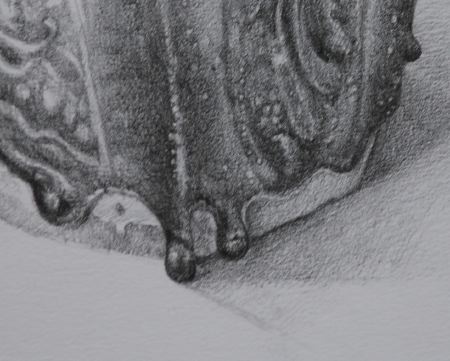
Black chalk on handmade paper, detail

I’ve been working on a new series of drawings. I will use some as a starting point for paintings. It’s all work from my imagination.

erotic_drawing_detail

black chalk on handmade paper, detail

When I draw I don’t worry about anatomy problems. I know I can sort all of that out later. Also, often the “problems” are what make the drawings say what I want to say.

erotic_nude_woman_black_chalk_handmade_paper

black chalk on handmade paper

This is just a small sample, with the most sexy parts cropped out. I think it is going to be something special.

I made this paper myself. It took a lot of research and work to learn to make it, but there was no other way to get what I wanted.

[2 April 2009]

New pencil drawings

Saturday, January 13th, 2007

By Hanneke van Oosterhout

Here are the drawings I have been working on in the new year.

(more…)

Drawing with children [Updated]

Thursday, January 11th, 2007

Earlier we came to an informal consensus that children’s art is not real “art.” I don’t see that as a problem, but it makes me curious: what are children doing when they draw? To try to get some insight, I’ve been drawing together with Nino and Fran. (more…)

Françesca on “Is children’s art ‘Art’?”

Thursday, January 4th, 2007

Is children’s art “art”? Steve said that age does not matter; Derek, June, Bob and Arthur were ambivalent. I thought I should ask a Françesca (four and a half years old) for her opinion about what she makes, and also about work by “grownups.”

(more…)

A question of viewpoint

Saturday, December 30th, 2006

Hanneke can’t post today and she asked me to fill in for her. I wanted to remark on an interesting trend in some of the comments about her work. For example, looking at an image of Old grapes, new painting, Colin Jago wrote “I seem to be looking down on the grapes and up at the glass.”

For Colorful Underpainting, Steve wrote “my first impression was that the cloth was somehow mounted on a wall. The bunch of grapes and the way they rest on it make this interpretation virtually impossible, of course, but I still don’t feel the correct perspective as strongly as I would like to.”

Hanneke paints her still life paintings “from life” and she tries to paint what she sees. Is she trying to show multiple viewpoints, or to produce distortion in perspective? Not intentionally, she has said. But is she doing so unintentionally?

Let’s take a look at Hanneke’s imaginary still life drawing and see if can find out more about the viewpoint issue.

In this imaginary still-life, the vessel is seen directly from the side, but the table top and fruit are seen from a different perspective, from above. We seem to look down on the table top while looking at the vessel from the side. This merging of different perspective points lends an interesting quality to the imaginary drawings. More examples of her “multiple viewpoint” imaginary drawings are here, here and here.

Let’s compare this to a drawing made directly from a real still life the same week when she made the imaginary drawings:

Do you see the difference? In this drawing from a real still-life, multiple viewpoints are not manifest. The fruit and the vessel are both seen from the same viewpoint.

I think that Colin and Steve are on to something with their comments about Hanneke’s painted still life work. In the “from life” still life paintings, the perspective may be technically correct, but she sometimes manages to produce a feeling of different viewpoints nonetheless. Would it be interesting if she tried to bring this difference in viewpoints more explicitly into her “from life” still life paintings? Or, should she work to correct the apparent flaw when it occurs?

Kids online: Interview with Françesca

Monday, December 25th, 2006

Françesca’s fifth birthday is coming up in March.

Karl: Who do you want to see your drawings?

Fran: All the people from the whole world, and also grandma and grandpa.

(more…)

Interview with Françesca

Saturday, December 23rd, 2006

Karl: Who do you want to see your drawings?

Fran: All the people from the whole world, and also grandma and grandpa. (more…)

Kids online

Thursday, December 21st, 2006

Not long ago, Françesca enjoyed typing random letters into a text editor for about ten minutes a day. Now that she is nearing five years old, that doesn’t satisfy her any longer. She learned how to use the mouse, and she’s beginning to understand how to use the Safari web browser. She can spend an hour on-line without a break.What to do? This is the point where Hanneke and I have a choice. We can take the computer away and have our kids grow up in a “traditional” pre-internet household. Or we can let them go online and accept the consequences.

I am of two minds about this. One view is that the kids should be able to grow up in an internet-free home, the way we grew up. The opposing view is that the kids should go online because the internet is part of the world we live in — keeping the kids away from it would be like refusing to let them learn to read or write.

I am torn between these two views, but I am leaning toward letting her go online because:

  1. Our kids will come into contact with the internet no matter what we do.
  2. By guiding her internet use at home, we can help Fran find and be involved in the positive things on the internet; for example, looking at artwork by other children her age.
  3. The internet is intensely stimulating, of course. My response is that we need to make our “off-line” home environment even more fun, more stimulating, so that the internet is not such a magnet for the kids.

Anyone else out there with similar problems / opportunities?

Old grapes, new painting

Saturday, November 18th, 2006

A drawing on paper (click image to enlarge):


. . .

Underdrawing on panel:

. . .

Underpainting with acrylic:


. . .

Overpainting with oil:


. . .

Overpainting with oil, second day (click image to enlarge):

. . .

Comments?

A painting a [in several] day[s]

Monday, November 6th, 2006

by Hanneke van Oosterhout

Recently we looked at one of Hanneke van Oosterhout‘s finished still life paintings. There were a number of excellent critiques. The painting was already sold, however, so comments could have no further impact on that picture.

Now Hanneke is in the progress of making another still life. It is not yet finished, which means that your comments could help her make this painting better.

We can follow the painting’s development over several days. (more…)

(un)still-life of the imagination

Saturday, October 14th, 2006
Imaginary still life in red chalk

Imaginary still life in red chalk by Hanneke van Oosterhout

Drawing still-life from her imagination has given a new dynamism to Hanneke’s work. Look at the rhythm of the forms she creates here. This looks like it would be awfully complex to paint (and where is she going to find a skull?).

Beer and snail

Tuesday, October 10th, 2006
Drawing by Hanneke van Oosterhout

Drawing by Hanneke van Oosterhout

I have to confess that I used to think of still-life as the most boring art from. Hanneke van Oosterhout’s paintings have raised my appreciation of ordinary everyday objects, which is nice. But her imaginary still-life drawings add a whole new level of intellectual and artistic interest for me in the still-life genre.

This drawing of a glass of beer is exciting despite being of a mundane topic. I think that working from imagination allows Hanneke to tap into a new level of creativity (sorry for the lousy pun).

Where she is going with this approach, what will be the final result, remains to be seen.

This snail doesn’t seem to like beer so much.

Drawing and Transferring

Wednesday, September 6th, 2006

Drawing can be done directly on a painting surface, but working on paper, and then transferring has advantages. Most obvious is that one can make many drawings and then select the best to transfer to a clean white canvas or panel. Another advantage is that drawing allows for experimentation with picture dimensions, before committing to a particular painting surface.

To transfer a drawing, without enlarging or reducing the size, tracing paper is useful. Tracing paper goes back at least to the 14th century (Cennino Cennini describes three techniques for making it). After the drawing is traced to the paper, it can be transferred to the painting surface in different ways. One is to rub the back of the tracing paper with charcoal, position the paper on a white grounded panel, then go over the lines with a hard pencil or stylus. This is the original carbon paper. Another technique is to prick holes in the tracing paper and then use a pouncing bag with charcoal dust to bring the design onto the painting surface. This is better for canvases, because it does not require the strong local pressure of using a pencil or stylus. Furthermore, it is easy to make a transfer, wipe of the charcoal dust, and make another, to experiment with different positioning of the design on the canvas.

Once the drawing is transferred (either in charcoal lines or dots), it must be fixed, using black ink or paint. Once this is done, the charcoal can be removed, and the drawing developed further before underpainting.

Life drawing and sculpting, continued

Monday, June 12th, 2006

The experience of sculpting from life, which gave me such a rich way of looking and working, made me question the value of the drawing that I normally do. Now that I am getting over the initial shock of sculpting from life, I begin to appreciate the contribution of drawing to the sculpting process. First, drawing is much faster, so capturing a sudden lively gesture is much easier in drawing. The proportions and details may be all wrong, but if the drawing captures the feeling of the gesture, then it is possible to get the other aspects right in the sculpture with a gradual working process. Second, I’ve realized that my life drawings contain more information that I thought, and the sculpting helps me to interpret the drawings more completely.

I also started working with wax today, which has the advantage that it is lighter lets me make figures that stand without any support.

I’ve been having a lively email discussion with the artist-sculptor who runs the Michelangelo’s Models website. Although the history of Michelangelo’s sculptural models is controversial (I discuss one viewpoint in an essay on the Sistine Chapel), the various proposals about his working methods can be inspirational for artists today. That is not to say one should be casual about evaluating Michelangelo’s methods, of course. It is only to say that even a speculative art-historical idea can be of value in the creative process, if it proves its worth in practice.

Dan Bodner on painting with photographs

Thursday, May 18th, 2006

“I walked into my new studio and this was the view, these water towers – which are typically New York. I thought, ‘yeah I should do that.’”

In early 2005 Dan Bodner changed the focus of his artwork from the human figure (painted from life or imagination) to cityscape. At the same time he began to use digital photography to study his subjects and his own work.

Bodner often makes photographs under conditions that would be difficult to paint from life, like the night scene above, or snow storms. He is in particular interested in the effects of city lights on the sky. From a large number of photos he selects a sample which he studies by making pencil drawings.

The drawings are not direct copies, but interpretations that combine elements from more than one photo. After he finds the composition, Bodner makes small oil sketches to study color. Then he makes a large painting based on all of these elements. In the end, some paintings are similar to the original photographs, others diverge substantially from the source images.

Photographs are not only Bodner’s subjects, but a way to study his own work. He has found that by making a photograph of a painting, he can see it as though looking for the first time. As Bodner explains, “By making the photographs daily, I can get a distance from the work as I’m painting it.”

Photography is associated with all aspects of Dan Bodner’s cityscape artwork, a connection which he finds appropriate. Bodner explains:

I want to use photography as a source for my work because we cannot separate how we see from the way photography has informed our vision. I think photography allows painting to be what it is today.


________
first part of this interview