Archive for October, 2006

Inspiration from Mr. Bartman, my art teacher in high school

Sunday, October 29th, 2006

Posted by Karl Zipser

I made this painting in the summer of 1985, when I was sixteen years old. I painted it over the course of several mornings, standing on a dock in Woods Hole, Cape Cod. This is one of my first landscape paintings in oil.
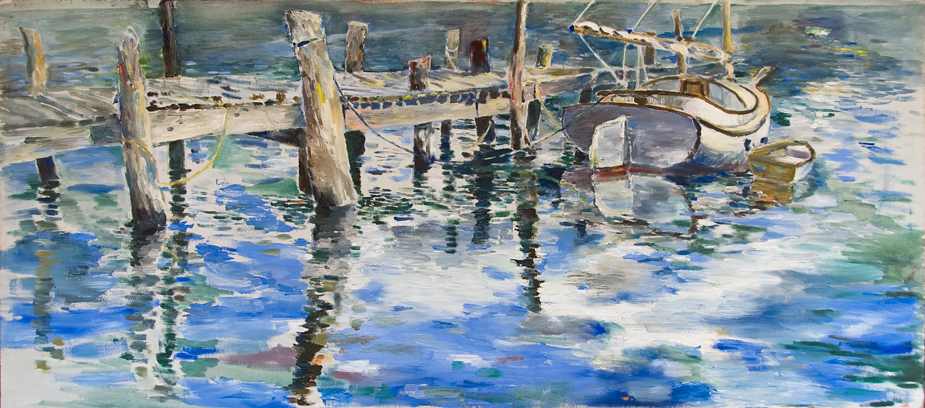
I was able to do work like the above because I was part of a group of motivated students in the art class of Walter Bartman, a high school teacher in Bethesda, Maryland. “Mr. Bartman” inspires his students to believe in art. The picture above I made during the summer vacation, outside of Bartman’s art class. And yet his spirit was there with me on the dock.

Later that summer I made this painting of the Mall in Washington D.C., in Bartman’s summer landscape class. I was most pleased with this picture at the time, and I still think it is pretty good.
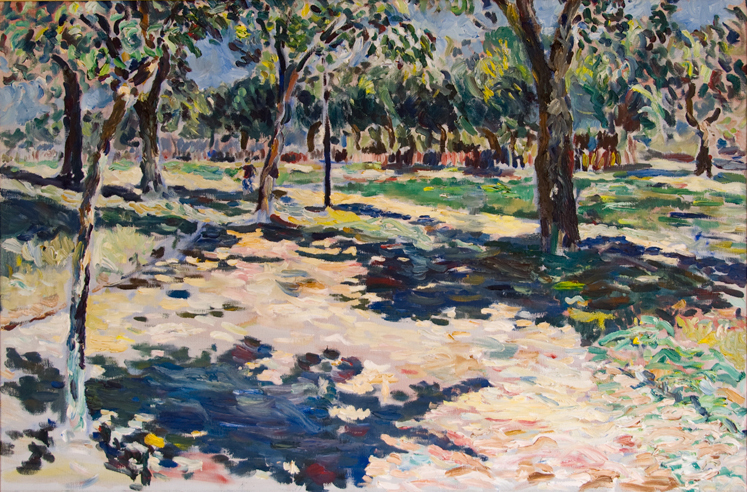
Walter Bartman had many outstanding young students during his teaching career at Walt Whitman high school (in a suburb of Washington D.C.) before he retired in 2001. Here is an interview I did with Walter Bartman.

Did you have a teacher who gave you a special inspiration for art?

From clay to bronze, and back again — works by Hanneke van den Bergh

Thursday, October 26th, 2006

Posted by Karl Zipser

Accidents Happen

Hanneke van den Bergh
‘s husband dropped this ceramic sculpture and it shattered on the sidewalk. Her 50 cm high wood-fired piece was a central work for the exhibition to be installed that day . . .

A year later Hanneke was still wondering what to do with the broken sculpture. She had reassembled and glued it together, but did not contemplate selling it. In the meantime, she had been experimenting with bronze casting on a small scale. Using this knowledge of casting, Hanneke decided to try to give new life to the damaged clay sculpture.

The lost wax method

Transforming the clay form to bronze requires an intermediate step, creating a wax replica of the sculpture. Hanneke made this wax form by making a rubber cast of the ceramic sculpture, embedded in a plaster cast. Into the empty cast she poured melted wax to make a hollow wax impression of the clay form.

When the wax version of the sculpture was ready, it gave Hanneke the opportunity to make new creative input. She modified the wax form, adding more interesting hair to the figures in wax, for example. The sculpture now combined the properties of both clay and wax forms.

To cast the bronze, the wax is embedded in a plaster and gravel column. The hollow interior is also filled with the plaster and gravel; Conduits for the bronze to flow in, and the air to flow out, are made. Then the plaster-gravel-wax mass is heated in a kiln, causing the wax to flow out and sublimate, leaving an empty shell of air where the bronze is to come. This is why this is called the “lost wax” method — the wax model is destroyed in the process.

Liquid metal

Bronze is heated to 1200 centigrade in a crucible. The molten bronze, with a consistency like cream, is poured into the mold. The pouring of the glowing, liquid metal is a spectacular sight. The sound is also surprising, the sound of a tall glass being filled with water from a pitcher.

When cool, the bronze sculpture is freed from the plaster and gravel, cleaned of excess metal, and given a patina, in this case green. The result is a new version of the original sculpture with an entirely different aesthetic effect (click images to enlarge.)

Unbreakable

The bronze version of the above sculpture can be dropped on the sidewalk without breaking. In fact, its structure does not even test the limits of what bronze can do. With metal as her production medium, Hanneke began to sculpt in clay in a different way, making figures such as this woman (which would yield a fragile form as a fired ceramic piece.) In bronze, this figure, based on a clay original, is stable even in this highly unbalanced mounting. Thus, the experience of working with bronze can influence the way Hanneke works in clay. Her work takes advantages of the best aspects of each medium — the plastic sensuality of the clay, the rigid firmness of the bronze.
For me a big lesson of my visit with Hanneke van den Bergh was that one should beware of talking with a bronze sculptor — one may find an irresistible urge to try this medium one’s self.

Do you have questions for Hanneke van den Bergh? Ask them here on Art & Perception.

What do you think of the bronze version of the ceramic sculpture? Is it stronger, in the aesthetic sense? Or just different? Should Hanneke van den Bergh stick with clay, or combine the media as she does?

Critique Me!

Wednesday, October 25th, 2006


Posted by Hanneke van Oosterhout

This still life is about 13 cm wide. I painted everything from life. I drew directly on the panel with charcoal, then pencil. Then I made an under painting in acrylic in one day. I made the over painting oil in two days, one day focusing on the berries, the other on the cup. I think this is a good picture. Please tell me what could be done better. Photographers, have you any insights for me?