China overtakes Germany as world’s largest exporter

The above headline and article from the BBC surprised me not because of China’s advance, but because I didn’t know that Germany was the world’s top exporter.

So I checked Wikipedia and found the following data:

1 Germany $ 1,498,000,000,000 2008 est.
2 China $ 1,435,000,000,000 2008 est.
3 United States $ 1,291,000,000,000 2008 est.
4 Japan $ 746,500,000,000 2008 est.
5 France $ 601,900,000,000 2008 est.
6 Italy $ 546,900,000,000 2008 est.
7 Netherlands $ 533,200,000,000 2008 est.

This surprised me again, because The Netherlands, where I live, has about a third of the exports of China. China has 1.3 billion people, we have 16.5 million. What would happen if we took population into account with the above top seven exporters?

Average dollar exports per person:

Germany $/p 18294
China $/p 1075
United States $/p 4187
Japan $/p 5853
France $/p 9249
Italy $/p 9080
Netherlands $/p 32157

The export per capita for The Netherlands is phenomenal, nearly eight times that of the U.S., and thirty times that of China. Top Dutch exports to the U.S.:

  1. Other petroleum products …US$4.2 billion (24.2% of Netherlands to U.S. exports, up 34% from 2005)
  2. Service industry machinery & trade tools … $1.13 billion (6.5%, up 50.7%)
  3. Wine & related products … $1.08 billion (6.2%, up 15.8%)
  4. Fuel oil … $840 million (4.8%, up 62.6%)
  5. Other scientific, medical & hospital equipment … $625.1 million (3.6%, down 4%)
  6. Medicinal, dental & pharmaceutical preparations … $610.3 million (3.5%, up 22%)
  7. Industrial organic chemicals … $532.8 million (3.1%, up 0.6%)
  8. Nuclear fuel materials & fuels … $483 million (2.9%, up 97.9%)
  9. Semi-finished iron & steel mill products … $400.8 million (2.3%, up 31.2%)
  10. Other industrial machinery … $355.2 million (2%, up 13%)

A quick look at this list suggests that a third of Dutch exports are fossil fuels.

How to Gild a Frame

A frame covered with acrylic gesso, ready to begin gilding process.

A frame covered with acrylic gesso, ready to begin with the gilding process. I have previously sanded the gesso with wet emery paper and polished with the finest paper where the gold is to come.

To attach the gold to the frame, I use a mordant which is simply oil paint with extra thick oil and some oil varnish blended in.

To attach the gold to the frame, I use a mordant which is simply oil paint with extra thick oil and some oil varnish blended in. When the mordant dries but is still sticky, gold leaf will adhere to it.

This picture shows gilding tools used for both water and oil gilding. The gold leaf is held and cut on a leather palette. A knife, similar to a painting knife, is used to cut the gold as necessary. Brushes are used to move the gold to the place to be gilded, and to press it into the mordant as necessary.

This picture shows gilding tools used for both water and oil gilding. The gold leaf is held and cut on a leather palette. A knife, similar to a painting knife, is used to cut the gold as necessary. Brushes are used to move the gold to the place to be gilded, and to press it into the mordant as necessary.

I use the flat brush to move the gold leaf to the frame and to press it gently onto the mordant. I work with the frame on an easel for two reasons: 1) so that dust doesn't fall onto the mordant; 2) so that I can use gravity to let the leaf hang down, allowing me to move it onto the mordant as I choose in the next step.

I use the flat brush to move the gold leaf to the frame and to press it gently onto the mordant. I work with the frame on an easel for two reasons: 1) so that dust doesn't fall onto the mordant; 2) so that I can use gravity to let the leaf hang down, allowing me to move it onto the mordant as I choose in the next step.

Then I use a soft paint brush to press the leaf further against the mordant. At first I don't attempt to smooth the leaf. It is better to have the leaf wrinkle than to have it stretch and break.

Then I use a soft paint brush to press the leaf further against the mordant. At first I don't attempt to smooth the leaf. It is better to have the leaf wrinkle than to have it stretch and break.

Here the entire mordant is covered with loose-fitting gold leaf. The next step is faulting.

Here the entire mordant is covered with loose-fitting gold leaf. The next step is faulting. I lay the frame flat on a table. Now my goal is to gently press the gold down into the mordant more completely. In the process, I want to detach excess gold and move it to places where more gold is needed. Having the frame flat lets me use gravity. If the frame were vertical, the excess leaf would simply fall on the floor before I could move it elsewhere on the frame.

Here I have removed much of the excess leaf, and filled in the gaps where there was no leaf.

Here I have removed much of the excess leaf, and filled in the gaps where there was no leaf.

Here I have smoothed down the gold and faulted. At this point I will set the frame aside so that the mordant can harden and I can rub the gold leaf to smooth out the little bits of leaf that remain sticking up. If I tried that at this stage, I might ruin the gilding.

Here I have smoothed down the gold and faulted. At this point I will set the frame aside so that the mordant can harden and I can rub the gold leaf to smooth out the little bits of leaf that remain sticking up. If I tried that at this stage, I might ruin the gilding.

After letting the frame sit for a week, I rub it with a fingertip and a smooth cloth to smooth off the final rough edges of the leaf. This must be done with great care.

After letting the frame sit for a week, I rub it with a fingertip and a clean smooth cloth to smooth off the final rough edges of the leaf. This requires great care.

How to a Paint Still Life

Stages in painting a still life in oil

Painting in layers with discrete stages (as seen above) is a powerful means to create realistic and expressive artwork. In this post I describe an example of the process with still life, although the methods are appropriate for any subject matter.

A simple underdrawing, black ink on a white gessoed panel. The black ink is high contrast against the ground. Is this a good way to start what I hope will be a subtle still life? In fact it is, because I am going to use a layered technique. The high contrast of this image introduces an important theme in layered painting: make something strong contrast, then paint over it to make more subtle contrast.

Stage 1) A simple underdrawing, black ink on a white gessoed panel.

The black ink in the drawing above has a high contrast against the ground. Is this a good way to start what I hope will be a subtle still life? In fact it is, because I am going to use a layered technique. The high contrast of this image introduces an important theme in layered painting: make something strong contrast, then paint over it to make more subtle contrast. [On the panel, the bowl is five and a half inches wide (i.e., 14 cm).]

Underpainting in oil

Stage 2) Underpainting in oil over the drawing.

The underpainting above is thin, direct and colorful, working out the basic forms without worrying too much about details in one painting session. Though the painting is thin, the drawing is now barely visible. If I had not used dark ink in the drawing, it would have been hidden by even a thin layer of paint; by using dark ink, I could still see the drawn details as I painted over the drawing. Before painting, the first thing I did was to mix the colors on my palette, where I could find a good color harmony.

In underpainting, I generally aim for warmer colors than I want in the finished work. I also added a little extra linseed oil to the colors so that they were a bit more fluid than straight tube colors. I generally paint without turpentine.

Look at how I apply the paint in the background in the underpainting stage above. It looks very streaky, doesn’t it? This is another example of making something high [or medium] contrast so that, after being covered by another layer or two, it will take on more subtle contrast. This streaky background pattern will later add a bit of texture to the painting, but it won’t jump out as it does now. Paintings that have smooth, perfectly blended surfaces tend to lack breath, they become suffocating and hard.

First overpainting

Stage 3) Overpainting, where I make the contrast stronger again, with attention to strong lights and darks.

Obviously, the underpainting (Stage 2) was dry before I painted over it. For the Stage 3, I use a bit of thickened linseed oil to make the paint more rich and rounded. I painted over the entire painting in one session, but quite thinly. The only thick parts are the highlights.

I’m accomplishing different things in Stage 3. On the one hand, I’m toning down some of the contrasts from Stage 2 (look at those streaks in the background, which can be seen in close-up in this post). But I also create some contrasts that are much stronger than I ultimately want to have (for example, the highlights on the fruit). The bowl and background are mostly finished at this stage.

Second overpainting

Stage 4) Finishing touches.

In Stage 4 I finished the painting with a final overpainting. I painted sparingly, but the results were dramatic. On the lights of the mandarins, I put on a very thin layer of orange to mute the overly bright highlights from Stage 3 and unify the forms. I played with the leaves a bit, and I worked on the front side of the table. I made subtle changes elsewhere as well, for example toning down the light on the left side of the bowl. Finishing a painting takes time, but most of the time is spent just looking and thinking. The actually brushwork in Stage 4 was probably no more than five minutes.

People interested in art generally think that traditional oil painting involves many layers of transparent colored glazes. This isn’t quite accurate. Yes, layering is involved, but rarely did artists of the past need to make many more layers than I use here. Also, much of layered painting involves painting translucently rather than transparently. I use transparent colors for the dark colorful shadows. But in many places, I use opaque colors (e.g., mixtures containing white) that are nonetheless translucent because I paint thinly. A bit of opaque color will prevent a transparent glaze from having too hard and glassy effect. Painting with only transparent colors in oil gives an unpleasant effect, I think.

Could I have done this painting with acrylics instead of oils? Perhaps, but I think it would have been more difficult. In another post I discuss the differences between the two types of paints with respect to painting in layers.

How to imitate lead white in oil

lead white

lead white


More »

New erotic drawings

black_chalk_on_handmade_paper1

Black chalk on handmade paper, detail

I’ve been working on a new series of drawings. I will use some as a starting point for paintings. It’s all work from my imagination.

erotic_drawing_detail

black chalk on handmade paper, detail

When I draw I don’t worry about anatomy problems. I know I can sort all of that out later. Also, often the “problems” are what make the drawings say what I want to say.

erotic_nude_woman_black_chalk_handmade_paper

black chalk on handmade paper

This is just a small sample, with the most sexy parts cropped out. I think it is going to be something special.

I made this paper myself. It took a lot of research and work to learn to make it, but there was no other way to get what I wanted.

[2 April 2009]

About Karl Zipser

Dune Landscape, 2006, oil on canvas
Dune Landscape, 2007
oil on canvas, 18 x 24 cm

I was born in New York City in 1969. My parents encouraged me to draw and paint from a young age. As a teenager, I painted landscapes in oil, but I felt that I should seek a more practical career.

I went to college at the University of Chicago and got my BA in biology in 1991. After that I did research at the Massachusetts Institute of Technology in the Department of Brain and Cognitive Sciences. I studied visual perception and the primate visual system. I got my Ph.D. in 1995.

During post-doctoral research in Amsterdam, I rediscovered my interest in art and decided to become a painter. I had an exhibition at Galerie Klerkx & van Heerden in Haarlem, The Netherlands in 2001. Since then most of my work has been for private commission.

What were the colors of the old masters?

colors-of-the-old-masters
These are color samples of historical pigments that I used in my own oil paintings. More »

Are acrylics just as good as oils for painting in layers?

Are acrylics just as good as oils for painting in layers?

The goal of painting in layers is to modify the appearance of one layer by putting another layer on top. This can be done nicely with both oil and acrylic paint. The problem is, how much paint to use in the second layer? Too little, and the first layer will remain dominant; too much, and the first layer becomes obscured completely, defeating the purpose of painting in layers.

Oil painting has the advantage that you can put on lots of paint, then take some away, put it back again, play with it, to get the thickness, the interaction between layers, just right. It is analogous to putting butter on bread: too much butter, no problem, scrape some off.

With acrylics, you need to build up gradually, being careful not to go too far, because the paint, once dry, won’t come off easily. This is more like adding salt to soup; too much salt, problem.

The different ways we can approach layered painting illustrates why oil painting is a more powerful technique than acrylic. Oil painting in layers encourages a bold approach, even for what seems like delicate, fine work. Acrylic layer painting requires more caution, gives less freedom.

Many people think of acrylic painting as easier than oil painting, but it’s actually more difficult in some ways. Hanneke uses it as a first layer for painting, for example with this still life and this still life. In both cases, she overpaints with oil.

[April 8, 2009]

Overpainting can be like a veil of mist

What does this photo have to do with painting in layers? mist-over-tree

The photo shows misty water vapor passing in front of some trees. The mist, which is like a thin layer of white applied as a layer on a painting, does three things:

  1. it makes the trees lighter
  2. it makes the colors cooler
  3. it reduces the contrast

More »

Three Still Life Paintings by Karl Zipser

Galerie George C-ent

Prinsengracht 100
1015 DZ Amsterdam

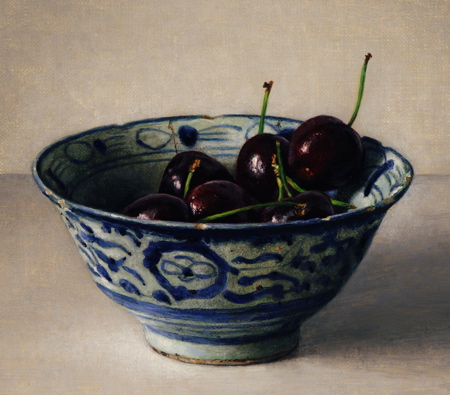
Majolica Bowl with Cherries, oil on panel

Majolica Bowl with Cherries, oil on panel (detail)
click here to enlarge


12 maart – 30 april 2009

Open: wo. t/m zat. 12.00-18.00
T.       + 31 20 66 54 485


Websites Ed Winkleman says artists should know

Edward Winkleman says these are the top sites for artist to look at: More »

Do you have a Problem with Turpentine?

Do you use turpentine? Do you wish you didn’t have to? I can use turpentine in the studio in winter, with the windows closed, but it’s not something I would like to do every day. Turpentine, even a small amount, can give me a headache. I am happy that turpentine (or some other organic solvent) is not a normal part of my oil painting technique.

Turpentine has two basic roles in modern painting: as a thinner for the paint to allow a flowing application, and for the purpose of cleaning brushes. More »

How to Store Oil Paints, part II: The Greatest Invention Since the Paint Tube

fold the foil in half

fold foil in half

You have a wonderful mixture of oil paint that you want to save. Or, perhaps you simply have a lot of paint on your palette and you don’t want it to dry up. What to do? The first step is to choose a piece of foil appropriate for the amount of paint you want to store. Fold in half, with the shiny side facing in. More »

How to Store Oil Paints, part I: Those Tricky Tubes

Being an artist is not the easiest way to make money; the people who most rely on having their paints in good condition are typically the ones who can least afford waste. Reliable paint storage is not a glamorous topic, but the more serious you are about being an artist, the more important it becomes to do it right.

The screw top paint tube is an important invention and it might seem simple to use, but it is not trivial. Every time paint is removed and the top is screwed back on, a bit of paint will find its way between the plastic top and the metal screw part of the tube. As this paint builds up, and time passes, bad things can happen. There are two basic categories of bad things. One is that the paint builds up in a way that makes it hard to close the tube properly. When this happens, there is the danger that the paint in the tube will dry, as in this photo.

dsc_4567-copy-450
When paint dries in the tube, it is worse than throwing money out of the window. It wastes time, it makes me feel stupid, and I’m stuck with the tube (who knows, maybe there is some good paint in there somewhere). More »

Travel with Oil Painting Brushes

Getting ready to roll brushes for a ride

Getting ready to roll brushes for a ride

The oil tray for storing brushes is very useful, but it is not the sort of thing that you would want to take on an airplane. If your brushes are linseed-oil damp and you need to take them someplace, say on a long journey, what should you do?

One solution is to clean the brushes with a non-drying oil, like olive oil, before taking them on a trip. Once you reach your destination, wash them several times with linseed oil, as with cleaning a brush of paint, to remove the non-drying oil. In practice, this is no problem. The greater danger is if you by accident mix up the linseed oil and olive oil and start painting with the latter. To avoid this, mix a small amount of color into the olive oil (maybe phthalo blue or something) to mark it as something different.

The bamboo rolling mat in the photo above is perfect for moving the brushes safely from place to place.